
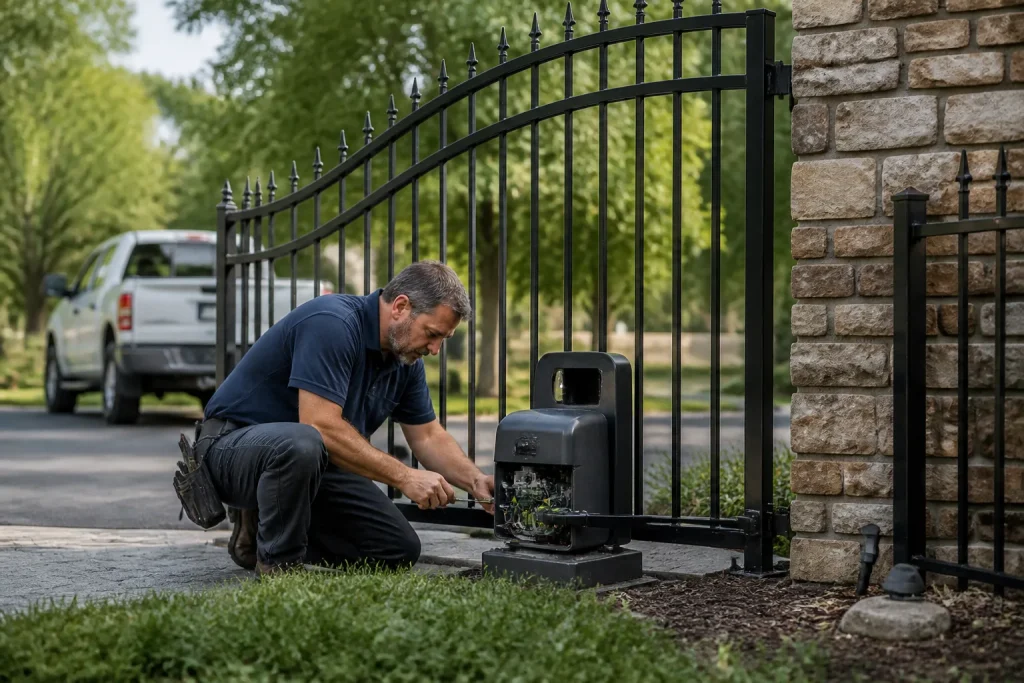
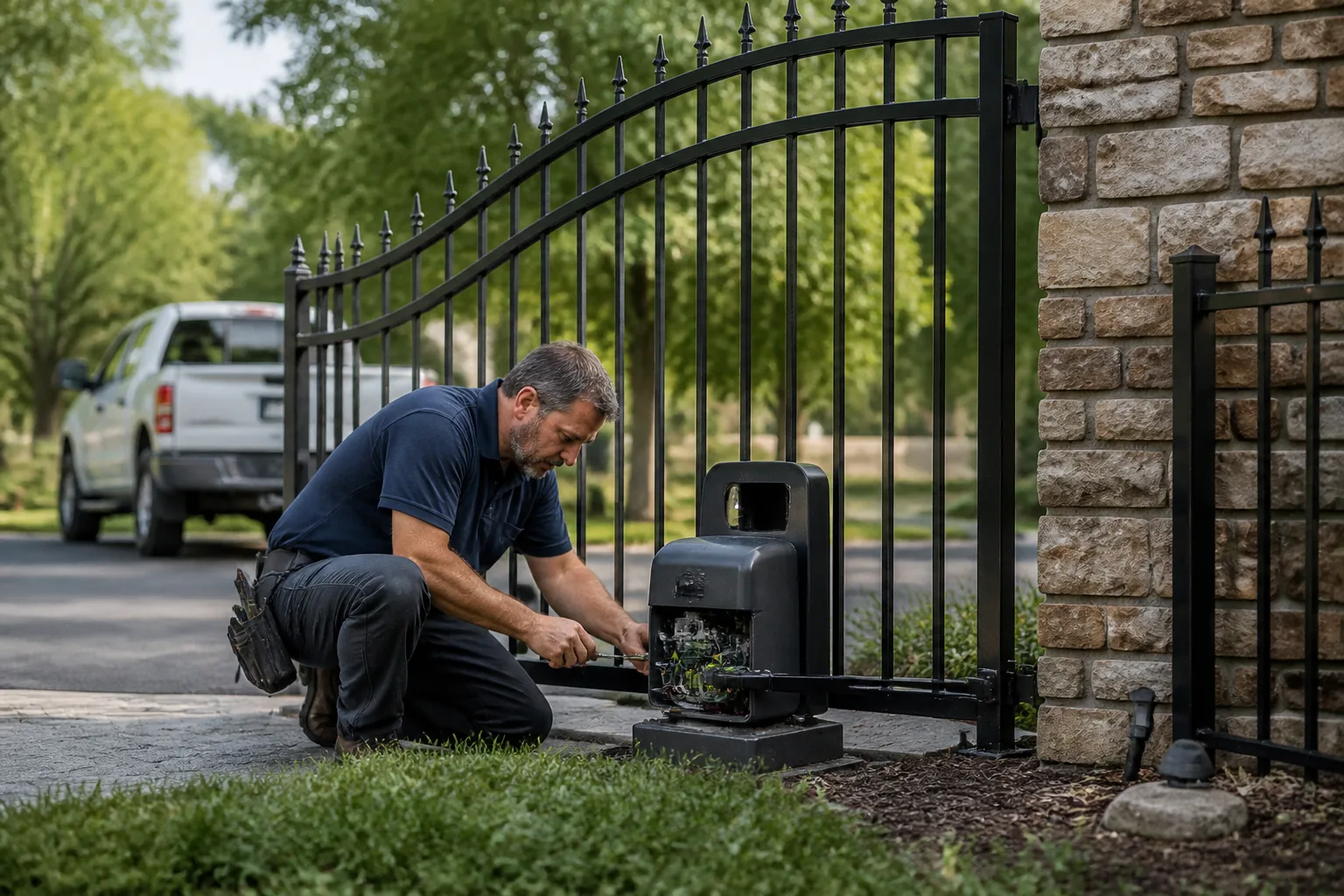
Emergency Gate Repair Near Me: What Albany Homeowners Should Do First
Forcing a stuck automatic gate open by hand without engaging the manual release correctly is how gate arms crack, hinges shear, and what should be a manageable repair turns into a much bigger one. We see versions of that mistake on Albany driveways more often than you’d think. The first ten minutes after a gate fails decide whether you’re dealing with an inconvenience or a safety problem, so this is a priority-ordered response, not a pile of tips. Work through it top to bottom.
If you’d rather skip the read and hand it to a specialist, call (866) 942-6084. We answer 24/7, and fast dispatch from 7am to 7pm gets a technician your way.
Step One: Engage the Manual Release Safely, Before You Touch the Gate
Engage the manual release before you push, pull or prop anything. On nearly every residential operator, there’s a release mechanism that disconnects the motor from the gate so the leaf can swing or slide freely. Done right, the gate moves with light hand pressure. Done wrong, you’re fighting the gearbox, and the gearbox wins by breaking something.
How the release works varies by brand, and the four we work on most around Albany each have their own quirk:
- FAAC operators typically use a key-release or a lever under a lockable cover. Turn the key fully, then move the lever through its full travel before touching the leaf. A half-turn leaves the clutch partly engaged and that’s where damage starts.
- BFT units often use a manual release lever reached through a small hatch in the housing. Let the gate come to rest on its own after releasing, then check that it swings or slides with hand pressure only.
- Linear operators commonly use a pull cord or a release key depending on the model. Pull slowly rather than yanking; the cord disconnects a drive arm, and abrupt force can bend the linkage.
- Viking operators often pair a release key with a lever sequence. Follow it in order and don’t force the lever against resistance.
If the release won’t move, or the gate still feels locked after it does, stop. That’s a mechanical fault that needs eyes on it. Call (866) 942-6084 and we’ll book a visit. This is also the point to say clearly: gate hardware is heavy, and a leaf that drops or swings unexpectedly can cause serious injury. Don’t stand in the gate’s path, don’t put your hands between the leaf and the post, and don’t try to lift a sagging gate off its hinges on your own.
Stuck Open or Stuck Closed? The Risk Profile Is Completely Different
A gate stuck closed is usually a security question. A gate stuck open is an access and safety question, and it’s the more urgent of the two. Treat them separately, because the right first move is different in each case.
Stuck Closed
Your property is still secured, so slow down and think. If you can’t get a vehicle out, park outside the gate and leave the leaf where it is. Don’t ram it, don’t push the leaf with a car, and don’t try to climb the frame. If the gate is the only access to your driveway and you’re blocking a sidewalk, move the vehicle and let us know when you call. A stuck-closed gate on a residential drive in Albany is usually diagnosed quickly once we’re on site, because the leaf is intact and we’re working on the operator and controls.
Stuck Open
This one you want to address within the hour. An open gate on a residential property is an invitation, and on a commercial property it’s a liability question as well. If the leaf can be walked back into the closed position by hand after the release is engaged, close it manually and treat the gate as a locked door you don’t have a key to. If it can’t be moved by hand, that’s a mechanical failure, and your priority shifts to a temporary barrier while you wait.
In our experience, stuck-open failures split roughly along two lines: an operator fault (power, control board, safety sensor) or a mechanical fault (broken hinge, cracked arm, a slide gate off its track). The first can often be reset or bypassed to get the gate closed. The second you should not force closed.
Electrical or Mechanical? A Two-Minute Check Anyone Can Do
You can usually tell which half of the system failed in under two minutes using nothing but your eyes and ears. Walk the gate from the operator outward and check the following:
- Is there power at the operator? Look for a status light, a lit display or an audible click when you press the remote. No light at all points to a power or breaker issue. Resetting a tripped breaker is a homeowner job. Opening a panel or chasing wiring is not; leave that to a qualified technician.
- Does the operator try and fail? A motor that hums, clicks, or runs for a second then stops is usually a control board or safety sensor problem. That’s electrical, and it’s our area: our technicians work on the control boards, loop detectors and safety edges that generalists routinely misdiagnose.
- Is anything visibly broken? Run your eyes along the arm, the hinges, the track and the rollers. A bent arm, a hinge pulled out of the post, a slide gate sitting off its rail, or a chain hanging loose is mechanical. Don’t cycle the gate to “see if it’ll work”; you’ll make it worse.
- Is the safety sensor blocked or knocked out of line? A leaf that stops and reverses immediately on closing is often a sensor issue. Look for dirt, a fallen branch, or a knocked-over reflector between the posts. Don’t reach through the gate’s path to check; it can move without warning.
If the answer is electrical, write it down. If it’s mechanical, don’t force anything. Either way, the next step is the same phone call.
What to Have Ready Before You Call
The faster you can give us these details, the faster we can get the right technician to your property. Have them ready before you dial:
- The gate type: swing or slide, single or double leaf, residential or commercial.
- The brand on the operator: FAAC, BFT, Linear, Viking and others are printed on the housing. If you can’t find it, a photo of the housing works.
- What the gate is doing: dead, cycling and reversing, moving by hand with the motor on, or stuck after the release was engaged.
- Whether the gate is open or closed right now, and whether you’ve secured it.
- Your address and a callback number, plus any gate code or access instruction we’ll need on arrival.
- Whether anyone is trapped or a vehicle is blocked, because that changes the priority order.
That list is short on purpose. It’s the difference between a technician arriving with a plan and one arriving to find out. We answer 24/7, so there’s no bad time to call. Fast dispatch runs from 7am to 7pm, Sunday through Friday. If you call outside dispatch hours, we’ll book you into the next opening.
Temporary Security While You Wait
You can make a stuck-open gate secure in under 30 minutes with what’s already on your property. Do these in order:
- Close the leaf manually if you can. Engage the release, walk the gate closed by hand, and re-engage the release. Then lock the leaf with whatever latch or padlock point the gate has.
- If the leaf won’t close, put a physical barrier behind it. A parked vehicle, a wheel clamp or a chain across the opening works as a temporary block. Make sure anything you place is visible after dark, and don’t wedge the gate against the operator arm.
- Aim a camera or a light at the opening. Move a security camera or a motion light so it covers the gate line. That’s deterrent, not a fix, but it buys you time.
- Tell anyone who relies on the gate. If it’s a shared drive or a managed property, let the other users know manually. Don’t rely on a neighbor to notice.
- Don’t barricade the gate in a way that blocks emergency access. If a fire truck or an ambulance needed to get through, it still has to.
None of that replaces a repair, and none of it is a substitute for getting a trained technician on site. It’s the gap-filler while you wait.
When to Call a Pro
Call a pro the moment the release won’t move, the gate won’t stay closed by hand, a hinge or post looks bent, or you suspect a control board or safety sensor fault. Those are the failures that get worse with time and force. Our technicians have up to 12 years of experience and work on both the mechanical side and the electronic side of a gate in a single visit, so you’re not coordinating between a handyman, an electrician and a gate guy who never quite agree on whose fault it is. Gate work is the only trade we do.
Related services in Albany: gate repair for mechanical and structural failures, and electric gate repair for operators, control boards and sensors. If you’re weighing whether to repair or replace, the Gate Repair Albany homepage covers the full picture.
The Bottom Line
Engage the release before you touch the gate. Know whether it’s stuck open or stuck closed, because the risk is different. Do a two-minute electrical-versus-mechanical check. Have your gate type, brand, symptoms and address ready before you call. Then get secure and get a technician booked. Every step on that list buys you something: a working gate, a safer property, or a faster diagnosis.
We’re a gate-only specialist. Whether your operator is a FAAC, a BFT, a Linear, a Viking, a LiftMaster or anything else on the driveway, we’ve worked on it, and we fix what you already have. Free estimates, upfront pricing, and the price is agreed before any work starts. If you’re in Albany and need help, Gate Repair Albany offers free estimates. Call (866) 942-6084. We answer 24/7. Fast dispatch from 7am to 7pm, Sunday through Friday. Closed Saturday.
Frequently Asked Questions
Engage the manual release first, then move the leaf by hand. On a FAAC, BFT, Linear or Viking operator, turn the key or pull the release fully through its travel and check the gate moves with light pressure only. If it resists, stop and call (866) 942-6084. Estimates are free.
Same day in most cases. Call (866) 942-6084. We answer 24/7, and fast dispatch from 7am to 7pm runs Sunday through Friday. Meanwhile, engage the release, close the leaf by hand if you can, and add a temporary barrier.
Often the control board, safety sensor or wiring rather than the motor itself. A motor that hums, clicks or runs briefly and stops points to controls. Our technicians work on the boards, loop detectors and safety edges directly, so it’s diagnosed correctly the first visit. Call (866) 942-6084 for a free estimate.
Gate type, the brand on the operator, what the gate is doing, whether it’s open or closed, your address, a callback number, and any gate code. That short list is what lets us dispatch the right technician faster. Call (866) 942-6084. We answer 24/7.
Almost certainly. We’re experienced across the major residential and commercial platforms, and we diagnose both mechanical and electronic faults in a single visit. Call (866) 942-6084 with the brand name on the housing and we’ll confirm. Estimates are free.
Written by the team at Gate Repair Albany.
Need Gate Repair Help?
Call Gate Repair Albany - licensed & insured, here with fast help in Albany.
(866) 942-6084